
AI development for regulated industriesAI you can prove.
Tech4Biz builds AI that cites what it relies on and passes an evaluation suite before every release, so you can show why it gave the answer it gave.

How it works
The same answer, with retrieval and without it.
Ask a question
Which contracts renew this quarter?
- Several contracts renew this quarter. [1]
- Two of them renew automatically unless someone gives notice. [2]
- The largest will probably be renegotiated. HELD BACK. NO SOURCE
ILLUSTRATION. NOT A RECORD.
With retrieval, each sentence that goes out points to the source it came from. The sentence with no source is held back.

Ask an agent the same question twice.
If the answers differ, no amount of fine-tuning fixes that.
What it covers
What audit-ready AI has to show.
- Bounded behavior
- The system’s behavior is bounded: you can state what it will and will not do, and the architecture enforces it rather than a prompt requesting it.
- Measured performance
- An evaluation suite with real cases runs before every release.
- Traceable decisions
- The system’s decisions are traceable: when an output matters, you can show what informed it.
- Reproducibility is a compliance property
- An auditor re-running last quarter’s decision needs last quarter’s answer.
From real work
Answers you can trace to a source, tested before every release.
Tech4Biz engineers AI systems that cite what they rely on and prove what they do. The model proposes. Retrieval, deterministic control and an evaluation suite decide what is allowed out.

Observation 01. Enterprise AI assistant
Exact answers from live data, beyond what search can give
- Every2hours
- data refresh, against a requirement of under 12
- 11
- read-only actions in the query service
- 17,295
- wiki documents searchable from the same assistant
Observation 02. Migration verification
A verifier that flags what it cannot check
- 412
- semantic mismatches flagged
- 8,700
- regression tests generated and run
- 14
- customer COBOL systems, about 0.2 million lines
Observation 03. Google Cloud AI
Five AI engagements for US businesses
- 5
- completed engagements
- Measured
- results after implementation, not projections
- 20 to 200
- employees at the US businesses served
The same principle runs through the AI systems Tech4Biz has built across insurance, banking, life sciences, media and operations.
Tech4Biz publishes its AI verification tooling. The COBOL equivalence verifier and the Determ8 gate pipeline are both on GitHub. Read the code
Client names stay private.
How it is built
Five decisions that keep an assistant honest about what it knows.
Drawn from an enterprise assistant for a large production company
Decision 01 of 05
Counts come from a live query.
A small read-only service answers counts, date windows and per-project filters from live queries. It returned an exact count of one project’s items by status.
Decision 02 of 05
Fresh data on a schedule.
The tracking system syncs every two hours, one job per type of record, reading only what changed since the last run.
Decision 03 of 05
Large telemetry stays where it is.
The company’s search cluster holds billions of documents, mostly agent telemetry. Nothing from it is loaded. That read-only service answers questions about compute-farm usage, failures and disk held from live tools.
Decision 04 of 05
Some documents never leave their owners.
HR and legal documents stay in users’ own drives and are kept out of the shared storage bucket.
Decision 05 of 05
Answers are scored on the company’s own questions.
A scorer runs the company’s question set against the app, and the company’s technical contact validates the answers on the day each test is run.

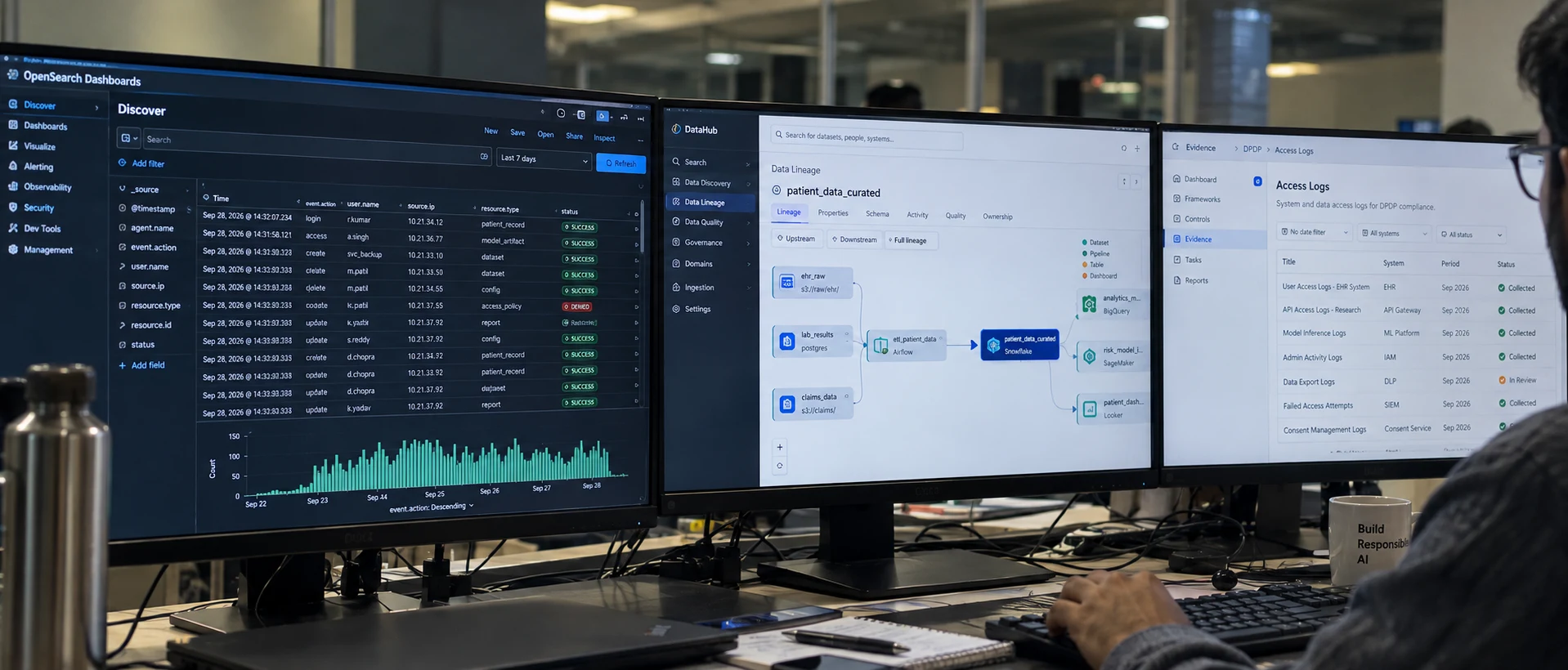
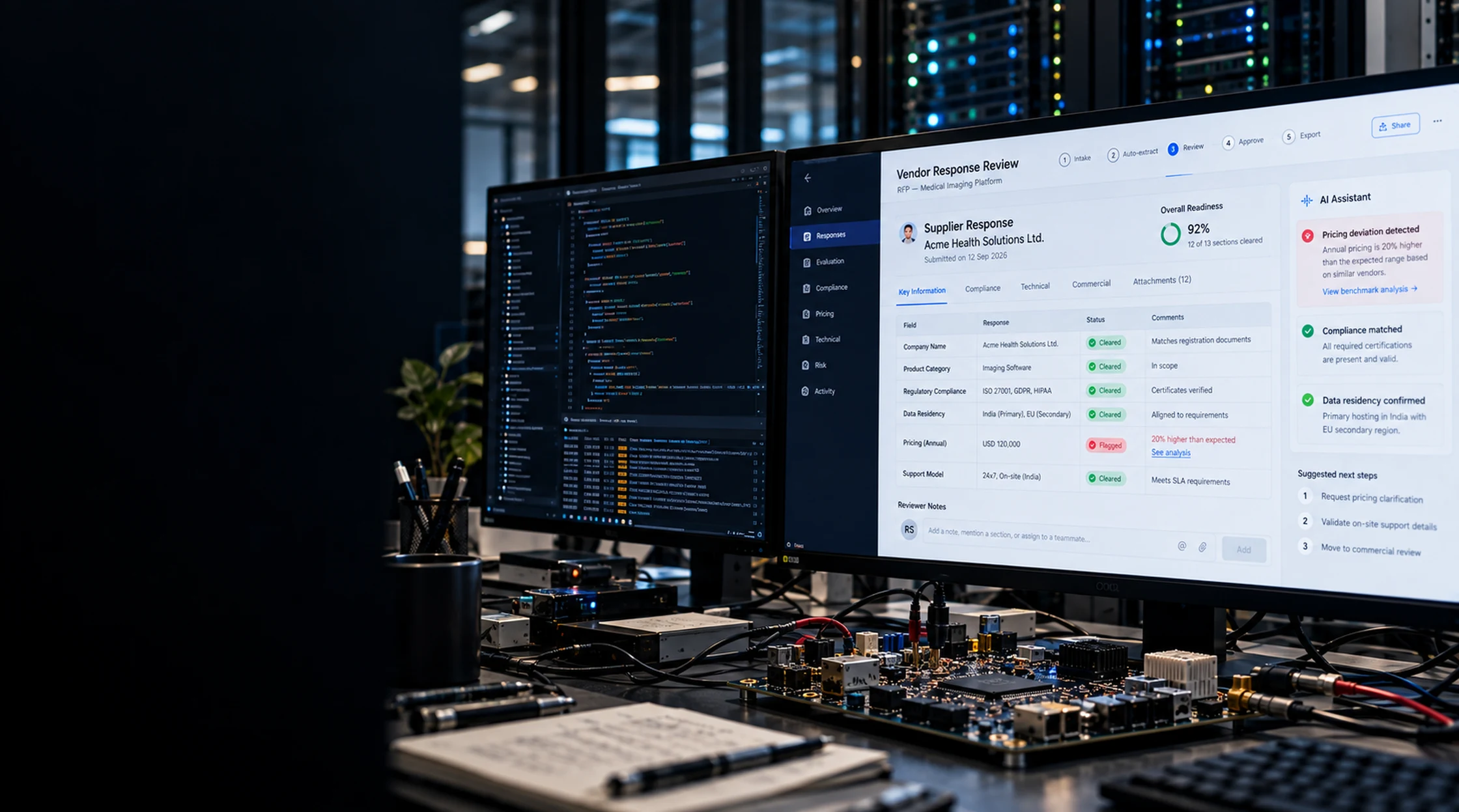
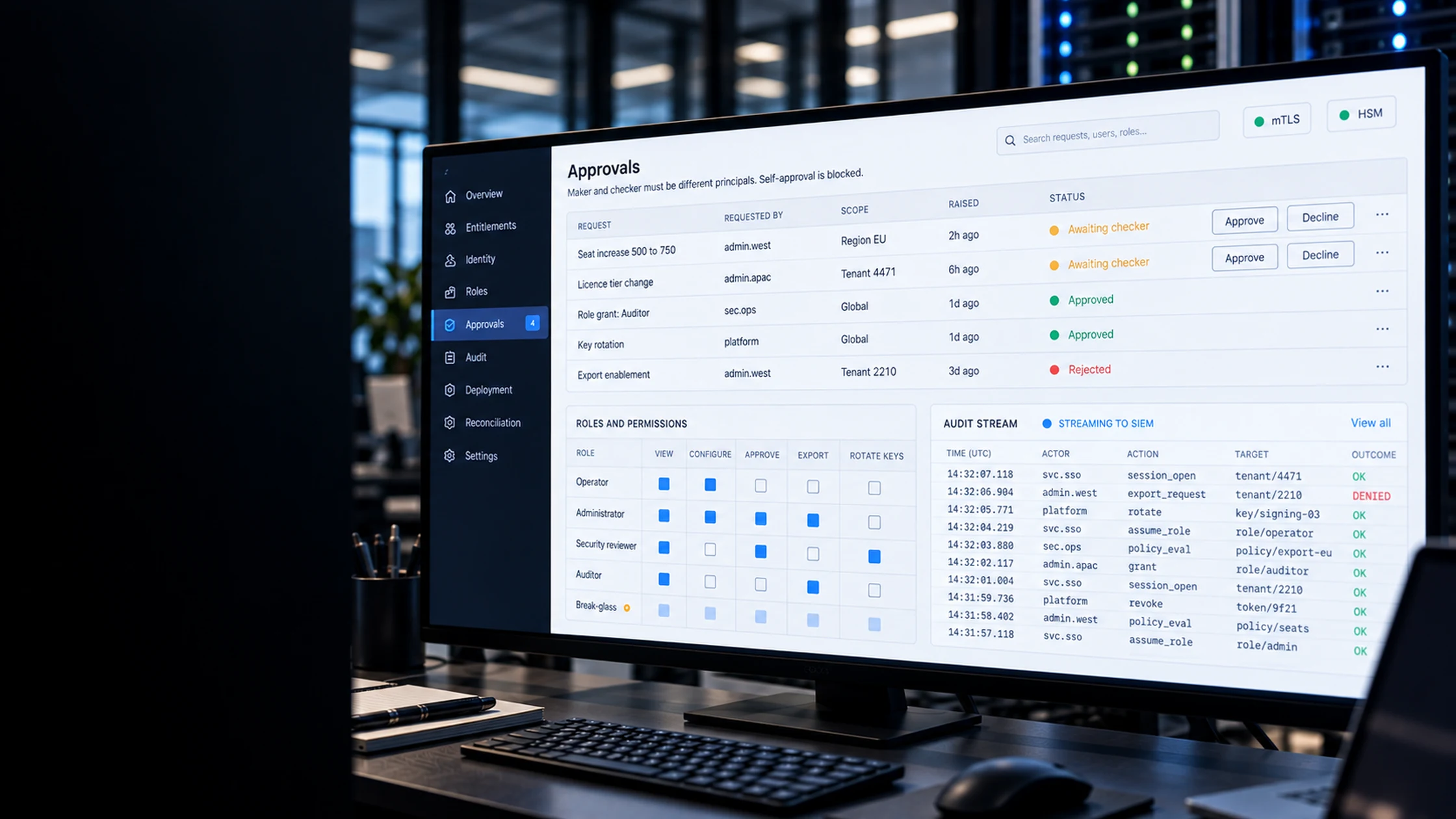
Focusing 1 of 5
Insights
Read more from our engineers.
How we engage
How the work is set up
- Team
- A dedicated pod, billed monthly, with a three-month minimum.
- Starting
- Within one to two weeks of agreeing what gets built, what gets left out, how payments work, and the roadmap after launch.
- Working hours
- 7am to 8pm IST, with calls until 10pm IST. That covers the US Eastern morning.
- Ownership
- All code and IP are yours on payment.
- Architecture only
- We can design the architecture for a team you already have. Your team then owns delivery. We take responsibility for execution only when our own team builds it.
Questions
Before an engagement
Should we build or buy?
Can you fix hallucinations?
Which models do you use?
What happens to our data?
Read the full explanation of the approach
Most AI vendors optimize for the demo. In a regulated setting the demo is the easy part; the hard part is the day an auditor, a regulator or your own risk team asks why the system gave the answer it gave. We build AI for that day.
What we do
Production AI systems where behavior is constrained, tested and explainable: retrieval architectures that cite their sources, agent workflows with deterministic control paths, model evaluation harnesses that run before every release, and the documentation trail regulators expect. We work inside your compliance frame, whether that is HIPAA, GxP, APRA CPS 230, DPDP or the emerging AI governance regimes.
What audit-ready AI actually means
It means three things are true at once. The system’s behavior is bounded: you can state what it will and will not do, and the architecture enforces it rather than a prompt requesting it. The system’s performance is measured: an evaluation suite with real cases runs before every release, so "the model got better" is a number, not an impression. And the system’s decisions are traceable: when an output matters, you can show what informed it.
Most AI deployments have none of the three, which is fine for a chatbot and disqualifying for a clinical, financial or safety context.
Why we lead with architecture over fine-tuning
We rebuilt a healthcare AI platform whose recall had stalled through months of fine-tuning. The gain came from changing the architecture, and we published the lesson because it generalizes: when an AI system is unreliable, teams reach for training when they should be reaching for structure.
Retrieval that cites sources, decomposed pipelines where each stage is testable, and deterministic control flow around the model do more for reliability than any amount of tuning, and unlike tuning, they produce evidence.
Determinism matters more than accuracy
Ask an agent the same question twice. If the answers differ, no amount of fine-tuning fixes that, and we have written publicly about why. For regulated use, reproducibility is a compliance property: an auditor re-running last quarter’s decision needs last quarter’s answer. We engineer for it with pinned models and prompts, versioned retrieval corpora, sampling discipline, and control paths that route high-stakes branches through deterministic code instead of model judgment.
What this rests on
Evidence you can re-run. An evaluation suite with real cases runs before every release.
Open tooling. Verification tooling published on GitHub for anyone to inspect.
Tier 1 enterprises. Tech4Biz works with Tier 1 enterprises. Examples include an enterprise assistant for a large production company and an AI platform for bank control assurance. Client names stay private..

Build AI you can show to an auditor.
Start the conversation →