What we do
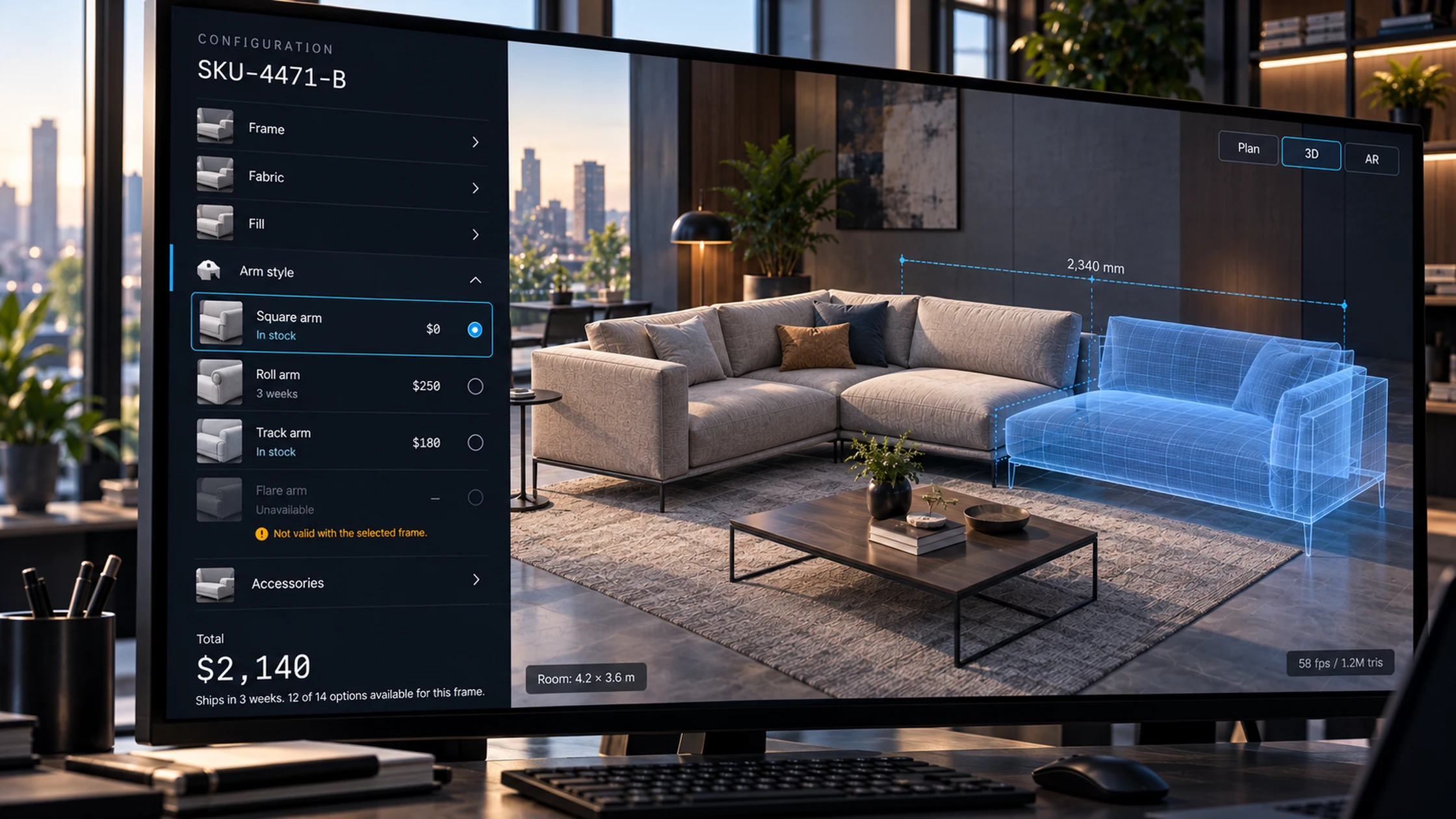
Real-time product configurators that let a customer assemble, arrange and price a product before committing. Room and space planners where the result is a layout somebody can actually order. Digital twins that take live data from a deployed system and show its real state rather than a stylised one. Spatial and immersive interfaces where the three-dimensional view earns its place rather than decorating a page.
All of it engineered to run in a browser, because an experience behind an app install is an experience most customers will not reach.
Why most of these disappoint
The demo is beautiful and the production version is slow, because nobody budgeted for geometry optimisation, texture streaming or the long tail of devices real customers hold. Or the configurator lets people build a combination the factory cannot make, which turns a sales tool into a source of cancelled orders.
We treat it as an engineering problem with a graphics layer, not a graphics project with engineering attached. The catalogue rules, the pricing logic and the manufacturing constraints are part of the build from the start.
Where it connects to the rest of what we do
A digital twin is only as good as the telemetry underneath it, which is the same pipeline work we do on industrial IoT. A configurator is only as good as its link to the catalogue and order system, which is ordinary integration done carefully.
That is why this sits with the engineering rather than beside it. The visible layer is the part customers touch, and the parts they never see are what make it true.
WHAT THIS RESTS ON
Browser first
Built to run without an install, on the hardware customers already have
Catalogue accurate
Configurations constrained to what can actually be manufactured and ordered
Live where it matters
Twins driven by real telemetry, using the same pipelines as our IoT work
How we engage
- Team
- A dedicated pod, billed monthly, with a three-month minimum.
- Starting
- Within one to two weeks of agreeing what gets built, what gets left out, how payments work, and the roadmap after launch.
- Working hours
- 7am to 8pm IST, with calls until 10pm IST. That covers the US Eastern morning.
- Ownership
- All code and IP are yours on payment.
- Architecture only
- We can design the architecture for a team you already have. Your team then owns delivery. We take responsibility for execution only when our own team builds it.
Questions we hear before engagements
Do we need our products modelled from scratch?
Not always. Existing CAD is often usable with optimisation work, which is considerably cheaper than remodelling. We assess what you have before quoting the modelling.
Will it work on mobile?
That has to be a decision at the start rather than a hope at the end. Mobile changes the geometry budget and sometimes the interaction model, and designing for it later usually means building twice.
Can it connect to our pricing and order systems?
Yes, and it should. A configurator that cannot produce a real, orderable, correctly priced result is a demo rather than a sales tool.
Related capability
If your system has to be right, let’s talk.
Start the conversation →